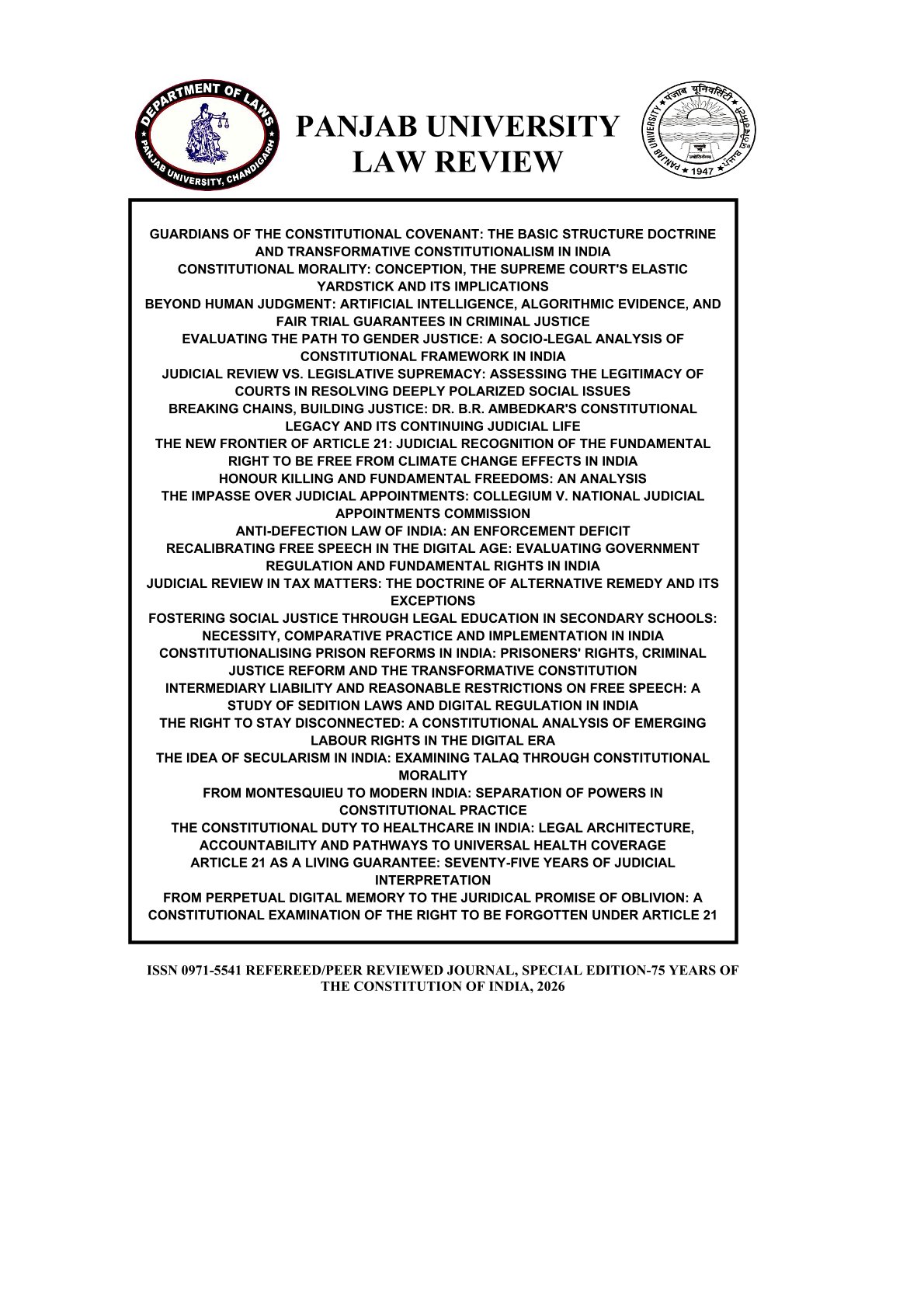
THE IDEA OF SECULARISM IN INDIA: EXAMINING TALAQ THROUGH CONSTITUTIONAL MORALITY
Keywords:
Secularism, Triple Talaq, Personal Law, Constitutional Morality, Essential Religious PracticesAbstract
India's constitutional commitment to secularism seeks to balance equality, religious freedom and individual right, a balance that becomes especially complex within personal law, and Muslim personal law in particular, where certain practices have historically produced gender-based discrimination. This paper examines the intersection of secularism and personal law with specific reference to talaq, tracing the legal journey of Muslim women from Mohd. Ahmed Khan v. Shah Bano Begum to Shayara Bano v. Union of India. The Shah Bano judgment marked a significant moment in Indian legal history by extending Section 125 of the Code of Criminal Procedure to divorced Muslim women unable to maintain themselves beyond the iddat period, prioritising constitutional principles of equality and social justice over a restrictive personal law interpretation, while the subsequent Muslim Women (Protection of Rights on Divorce) Act, 1986 reflected the continuing tension between religious autonomy and state intervention. The paper analyses the constitutional provisions governing secularism and religious freedom under Articles 13, 14, 15, 21, 25 through 28 and 44, alongside the landmark decisions shaping the scope of religious freedom and state regulation, and critically evaluates the essential religious practices doctrine, the judiciary's evolving posture toward personal law, and the implications of criminalising a personal law practice through the Muslim Women (Protection of Rights on Marriage) Act, 2019. The paper concludes that the regulation of religious personal law in India remains an evolving constitutional process rather than a settled position, and that reconciling secularism, gender justice and religious freedom requires continued attention to constitutional principle, judicial restraint and legislative sensitivity in equal measure.
Downloads